
Struggling to Fund Your Startup? Read This Before You Apply Again
Have you been rejected for start-up funding? Are you stuck in a cycle of applications with no desired outcome? It is indeed annoying as well as expensive. Each failed attempt wastes crucial time, shatters your confidence and hurts your overall credit score.
What is the main issue? The problem is that most founders are not able to identify the real reason. Then, what is the reason? Here it is:
Start-up funding is not the only matter of qualifying. Instead, it is about your company’s position, business duration and growth strategy.
This detailed guide focuses more on the reasons impacting the decisions on a start-up business loan in the UK. It will also discuss how you can connect with the lenders and what they are actually looking for from you in 2026.
What is the actual reason start-ups struggle to get funded?
- The Primary Reason: UNCERTAINTY
The major concern of the lenders is the risk of funding the start-ups. They are uncertain about their financial capacity. Why they consider it a high risk is that a start-up cannot demonstrate:
- How will it generate revenue?
- How will they manage the repayments?
- How will they survive when the market fluctuates?
Furthermore, they are not able to convince lenders at their early stage because:
- Start-ups do not demonstrate a clear business model
- There are unrealistic revenue assumptions
- No evidence of their products’ demand
In simple words, if your loan application generates more questions than answers, you usually receive rejection from the lenders.
Why there is a shift in start-up funding in 2026?
The UK business funding scenario has changed significantly. Things are outdated now, when new businesses generally convince the lenders to get capital on moral grounds.
- Data-driven Approach
Nowadays, decision-making has shifted to data-driven. What does it mean? It signifies that lenders want to analyse data available related to the start-ups:
- How consistent are these companies in sales, contracts and main projects?
- How much engaged they are in terms of their websites’ traffic, and enquiries?
- How proficient are they in market demand determined with research?
Is there an end of the road? Not at all. You can still convince the lenders even if your business has not been generating enough revenue. You can do this with:
- Agreements with partners and suppliers
- Evidence of pre-orders or deposits
- An increasing waiting list
These factors will help you in reducing the considerable risks and enhancing trust among the lenders.
7 ways to improve your chances for start-up funding in 2026
Never mind if you have seen multiple rejections in a short time. Follow the experts’ tips below and learn how to get start-up funding with firm chances:
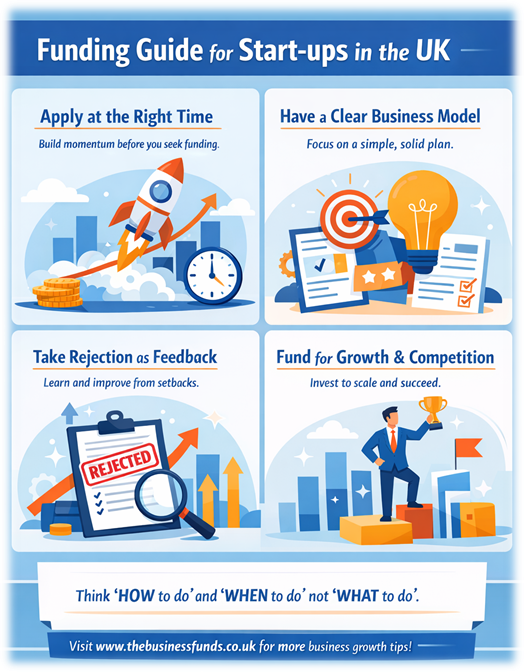
1) Apply for funds carefully
You do not want anything costing you loan approvals. Many start-ups make mistakes by submitting applications to multiple lenders. They do so by hoping that any one of them will approve their loans.
This strategy will cost you badly because each loan application;
- May face a mandatory credit check
- Can reduce your financial credibility if you face continuous rejection
- Shows that you are desperate to get funds instead of being prepared
Different lenders have different lending criteria. You make sure there is no difference in your profile and loan requirements. Otherwise, rejection will be there.
The Smarter Strategy:
- Research for the specialised lenders for start-ups
- Understand the standard loan requirements
- Fitting your business loan application accordingly
One well-prepared application is more effective than making multiple ones.
2) Prepare a business profile that attracts funds
You may think that your business plan is enough to attract the lender’s attention. But you should understand that your business plan is just a document.
On the other hand, lenders usually evaluate your overall financial profile as a loan applicant or a company owner. You need to focus on a fund-centric profile, which includes:
- A comprehensive revenue model
- Evidence that people want to buy your products
- Genuine use of the loan amount
- Perfect match between funding requirement and current business stage
For instance, suppose you want £80,000 to borrow for a new retail business. But you lack proper evidence that your products are attracting people. It definitely creates doubt among the lenders. Instead, asking for £20,000 with an already tested scenario increases your credibility among the loan providers.
3) Focus on strategic funding rather than urgent one
Being a start-up company, you must be desperate to get funds. Actually, it is a poor decision. You will be thrilled to get the first funding option, but overlook its long-term outcomes. What does it mean?
- High repayment burden
- Cash flow gaps
- Limited opportunities for growth
Avoid these situations. Instead, stay patient and prepare a business strategy to match it with funding requirements.
Consider:
- Do you need funds for growth or survival?
- Is your new business capable of making repayments?
- Will the loan amount help you in fetching considerable returns?
Now, why are these questions necessary to answer?
- Short-term business loans are perfect for filling cash flow gaps instantly
- Long-term loans for businesses are better for expansion
Making the right start-up funding option is quite important to get approval.
4) Take advantage of your business position
Want to influence the lender’s decision on your loan application? Present your business position effectively and explore its advantages.
There may be another start-up that has equivalent numbers as yours, but the outcomes are different. It is because their way of presenting their business is different.
Strong positioning of your business should have:
- Clarity with streamlined business model
- Confidence in demonstrating business direction and purpose
- Credibility in illustrating that people are getting attracted to your products
While interacting with your lender, avoid saying “We need funds to grow my start-up”. Instead, you should say, “We have covered the maximum cash flow demand through our previous customers, and now want funding to scale business operations and boost revenue capacity.”
This positioning makes your loan application from risky to fundable.
5) Know your preference: Speed or Cost
Instant funding is always your priority, but it is often available with higher loan costs. Lenders offer fast funding, which usually comes with the following consequences:
| Fast Funding | Lower Loan Cost |
| Lenders offer quick funding, but at considerable risk | Stricter credit assessment and longer loan process duration |
| Higher interest rates or fees | Repayments are manageable, and almost no chance of missing one |
Being a start-up, maintaining the balance is crucial. Therefore, you should be prepared for it by evaluating:
- Affordability
- Loan’s impact on monthly cash flow
- Total repayment amount
When you opt for faster funding options like unsecured business loans, your focus should be on solving the problem, not creating a new one.
6) Understand the importance of a Broker
Aspiring for the right start-up funding requires the right sources. A commercial business loan broker can be an effective source. Yes, they hold the major responsibility of connecting you with the lenders, matching your financial profile and circumstances. However, they cannot promise guaranteed approval either.
To have the best services of the loan broker, you should:
- Be clear in revealing the true financial situation
- Provide complete and genuine information
- Illustrate actual funding needs
You should understand that a broker can only be effective if you submit a quality loan application. You should think of a broker to ‘match’ your needs with a suitable loan deal rather than doing a ‘miracle’.
7) Timing of borrowing holds key
The timing of applying for a business loan should be part of your strategy. You should apply when your business is capable of showing any sign of growth and sustainability. Applying too early won’t be beneficial for you.
Strategise this with these points:
- Confirm your first few customers
- Show ability to get early revenue, even if it is in a small amount
- Evaluate your products’ demand in the market
Timely borrowing helps you to gain certainty. If your business is moving ahead steadily, funding becomes easier to secure.
In a Nutshell
Your inability to get sufficient start-up funding in the UK is momentary. Your idea is correct, but your loan strategy needs amendments. Most start-ups succeed in convincing the lenders to secure funding because they:
- Understand what lenders want
- Position their business evidently
- Take broker’s guidance strategically
‘Seeking money’ is not what you want. Instead, ‘providing value’ to your loan application creates more chances of approval.
Are you prepared to apply for a business loan more smartly?
Do these before submitting the next application:
- Assess your affordability
- Strengthen your business position
- Choose the right lender
You get success in start-up funding by NOT APPLYING FOR MORE. Instead, APPLYING FOR BETTER.


