
What are Business Purpose Loans? The UK Business Owner’s Guide 2026
The UK economy has been seeing a lot of ifs and buts. A few industries have seen strong “capital” growth, while others are facing “challenges”.
Talking about the capital, it is the backbone, particularly for the small and medium-sized enterprises (SMEs). They are spreading particularly across Manchester, Glasgow, Sunderland, Leeds, London, York, and Bristol. They want to grow, and their primary purpose is to gain maximum capital.
This is why business-purpose loans have become essential. These funding options can help manage the complexities of the modern business world.
In 2026, the UK market will embed a variety of funding options. It means people are moving beyond traditional bank loans to specialised loans from alternative lenders.
This guide discusses everything you need to know about business-purpose loans and choosing the right deal for your company.
What are business purpose loans in the UK?
Business-purpose loans are the type of business loan tailored particularly for commercial purposes. You have to use the borrowed amount for business-related activities, such as expansion, growth capital, and daily operations.
To get the loan, you must meet the standard eligibility criteria. For instance, you must be a director of the UK-based company. Besides, lenders will perform a credit score check on the business and the director’s personal credit.
If your credit score is not perfect, you may opt for guarantor business loans in the UK. These require a guarantor to guarantee your loan repayment. It provides an extra layer of security for the lender and increases your chances of loan approval.
We suggest that you first analyse whether a guarantor loan is suitable or a Merchant Cash Advance (MCA) is a better option. However, MCA generally works on the card sales.
Why do UK businesses need business purpose loans?
Most lenders usually ask one of the most important questions. “What is the purpose of this loan?” Now, it is up to you. Providing a business loan purpose best answer is not easy. You may think that you need to tick the box. It is not as such. Instead, it illustrates your company’s Return on Investment (ROI), strategy and growth plans.
Lenders prefer funding companies that seek to borrow to generate more capital rather than add more debt.
There are some common business-loan purpose reasons. These generally involve running smooth operations, handling seasonal fluctuations, or purchasing assets. A well-organised credit application usually carries 6 business objectives:
- Growth: Spreading commercial wings into new markets or opening new locations.
- Profitability: Gaining profits by saving costs and getting maximum revenues.
- Sustainability: Transferring to green energy or ecological supply chains.
- Efficiency: Investing in technology to modernise the internal procedures.
- Market share: Using the loan amount for dedicated marketing or business purchase funding to beat competitors.
- Retaining employees: Required funds to train staff or embed better facilities to retain skilful talent.
What types of loans are the right fit to fulfil business purposes?
The UK loan market never disappoints businesses, offering an array of loan products for various purposes. Sometimes, you need to choose between the interest rate and the speed of the application if you are looking for fast business finance.
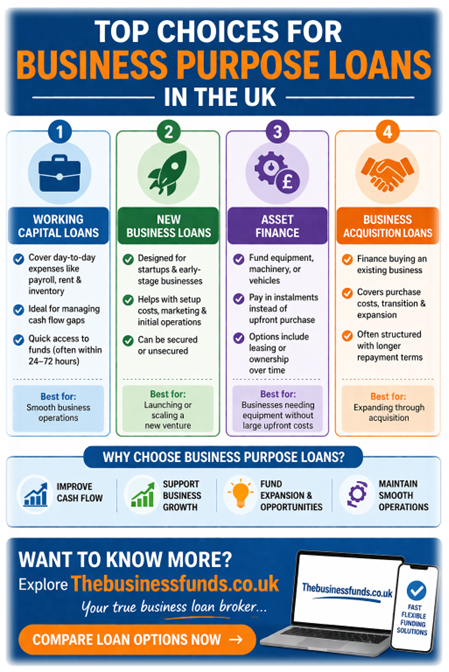
Working capital or cash flow loans for businesses are designed to improve cash flow, particularly in industries such as construction and retail. However, these are short-term financing options that help cover expenses like payroll or rent while waiting for client invoices to clear.
- New Business Loans
Challenges are many for new businesses just starting. Obtaining new business loans in the UK can be difficult through traditional bank loans. However, the government has supported them effectively through its Start-up Loan Scheme.
Alternate lenders are also ready to help start-ups by offering unsecured business start-up loans in the UK. Individuals aged 18 or above can borrow up to £25,000 for a business with less than 36 months of trading history.
It is among the most common forms of business financing. Asset-based finance is used for a specific purpose, such as purchasing machinery, which is standard in industries like manufacturing and logistics.
In this funding option, the asset is used as loan security, which helps obtain competitive-rate loans.
- Business Acquisitions
Options like business buyout loans are effective for ventures looking to expand. These loans to buy a business bring sufficient funds to acquire a competitor or related firm. Remember, these are challenging transactions that may require a comprehensive business-purpose commercial loan application.
Here is the brief summary of common loan purposes according to the typical UK industries:
| Industry | Common Loan Purposes | Loan Amount |
| Construction | Cash Flow Gaps Purchasing heavy equipment Project financing | £10,000 – £500,000+ |
| Retail | Buying stock inventory Shop renovation Seasonal demand planning | £5,000 – £250,000 |
| Logistics | Expansion Vehicle purpose or maintenance Warehouse improvements | £15,000 – £300,000 |
| Hospitality | Refurbishment of premises Hiring more staff Updating equipment Working capital | £5,000 – £200,000 |
| Healthcare | Clinic expansion Purchasing medical equipment Paying wages | £10,000 – £400,000 |
What are the advantages and disadvantages of business-purpose loans?
| Advantages | Disadvantages |
| Get business loans on instant decision | Increased debts |
| Use funds for any business purpose | Possible fees and extra charges |
| Helpful for small business growth | Affect your credit score if you miss repayments |
| Multiple loan schemes are available | Risk to the asset if a secured loan is applied |
| Predictable repayment with a fixed rate of interest | Sometimes high interest rates for an unsecured loan |
How to apply for a business purpose loan?
Here is how a commercial purpose loan works:
Decide how much you need: Analyse how much money you require to fulfil the business purpose. For a better idea, use our business loan calculator to estimate the right borrowing amount.
Choose loan type: Decide which loan suits your needs and affordability.
Compare lenders: Start comparing lenders available in the panel of Thebusinessfunds. The business loan broker has set an advanced platform to compare and analyse the different interest rates and repayment terms.
Request a business loan quote: Once you select the lender, ask them to share the quote.
Apply for the loan: The time to apply for the loan. You can submit the application online to save time.
Receive the loan amount: Many business loan lenders in the UK now offer instant decisions.
How to navigate the loan amount and term of business purpose loans?
The amount and term of the loan generally depend on the type of lender you pick. Technically, the lenders categorise these loans into two parts:
| Short-term Business Loans | Medium-Term Business Loans |
| These start at £5,000 business loans or 7k loans, which are perfect for small companies looking to advertise or upgrade equipment. You can have a simple loan application for business purposes, as these are unsecured loans for business. | A £25,000 business loan is ideal for start-ups looking to make their mark in the market. Besides, a £50k business loan can help existing ventures hire more staff, expand their business, or renovate their office premises. |
Most lenders offer these loans generally as 5-year business loans. This business term loan seems ideal for managing monthly repayments and the interest applied. It may also set a strong base for the business’s long-term commitments.
What is the rate structure applied to commercial-purpose loans?
The total borrowing cost is primarily based on the Bank of England base rate. It has been an important factor in business funding. Based on earlier trends, the base rate has been around 3.75%, but it keeps changing. Speak to our loan expert to know the current rate and how it impacts your business.
The UK loan market offers both fixed and flexible interest rates.
Fixed interest rates: These rates provide a clear idea of the monthly repayment you need to make. It won’t change throughout the life of the loan.
Variable interest rates: These can change with market fluctuations. You may find these cheaper initially, but later they may prove costly as the base rate rises.
Risks of Business loans for the purpose: An Indication
You should watch out and analyse the possible risks involved with these loans.
Early repayment charge: This is extremely crucial to consider. Some lenders retain the early repayment fee provision because they incur interest costs.
Affect your credit score: Applying for a loan may affect your credit score. Always find a loan deal that includes a soft credit score check.
Indulging in debts: If you apply for too many loans, you get trapped in debt. If your debt-to-income ratio rises, it can lower your credit score and reduce your borrowing chances in the future.
Tips for a successful business purpose commercial loan application
You should do all the planning and hard work to post a successful loan application for business purposes. It does not matter whether you are applying for a quick business loan or a larger loan. Your application should have these details:
- Detailed business plan
- Financial predictions
- Bank statements
- Tax returns
- Updated credit report
Expert Advice: Applying for an unsecured loan requires a strong business and personal credit score. Therefore, your personal finances should also be in good condition before submitting the application.
Conclusion: Walk strongly on your business journey
Getting a business purpose loan in the UK is no longer challenging. With the presence of responsible lenders and brokers, you can prepare well and understand the diversity of options available.
From fast business finance for emergency purposes or a 5-year business loan for larger purposes to fulfil, you can have ideal solutions to explore.
You should understand that the best loan is not the one with the lowest interest rate. Instead, the best loan is one that provides timely support for your business needs, such as buying a new van, financing a buyout, or maintaining steady cash flow. The UK’s loan market in 2026 is there to lead your business to succeed.
Disclaimer: The provided information in this guide is for informational purposes only. It does not manipulate or monitor financial advice. Consult with an experienced financial advisor before making any financial decision.

Lee Copper is an experienced financial content specialist helping businesses explore the UK loan market. He writes guides led by experts on business loans and finance products. His work follows strict editorial values to ensure reality, applicability, and simplicity for readers to make well-versed financial decisions. Lee creates in-depth guides backed up by research, industry best practices, and the latest market developments.


