

What is a Merchant Cash Advance and How Does It Work in the UK?
The UK business sector has been running at a fast pace. In such a scenario, cash flow isn’t just a part of your growth, but it is like the lifeline of your business. Whether you are running a dental clinic in Manchester or a restaurant in Leeds, you cannot wait for days or weeks to get a traditional bank loan.
Here comes merchant cash advance (MCA). It can be a part of traditional business funding but merged with modern features.
Here are some vital stats to consider:
The UK finance market has progressed a lot, where the approval rates of MCAs have been around 80% or more. It is much better than the mere 35% of small business loans. The average merchant cash advance amount is approximately £18,500.
There is another data where more than 60% of small and medium enterprises are now using alternative business funding to monitor cash flow instability that has occurred due to recent mutable inflation rates.
But what does it mean to have a merchant cash advance in the UK, and is it an effective finance solution for your business? Let us discuss in depth the mechanism, costs and comparative analysis of one of the most preferred short-term funding options.
What is a Merchant Cash Advance?
Before defining, it is important to mention that a merchant cash advance loan is not a ‘loan’ legally. Instead, it is like a purchase of your future card sales.
Unlike a loan, where you borrow money and repay it in fixed monthly instalments with interest, the provider of a merchant cash advance buys a part of your future revenue. It gives you a lump sum straightaway. You pay it back with a fixed repayment percentage of each sale you do through a credit card or debit card.
In other words…
It does not come with an Annual Percentage Rate (APR) like a loan. In place of that, it is technically a “PURCHASE OF ASSETS” in the form of your future sales. Instead of an interest rate, you and the provider deal with a FACTOR RATE. It is comparatively a flexible option, making it easier for businesses to be tied up in the strict criteria of traditional banks.
How Does a Merchant Cash Advance Work?
The significance of a cash advance for a small business is illustrated in its simplicity. Here is how a merchant cash advance works:
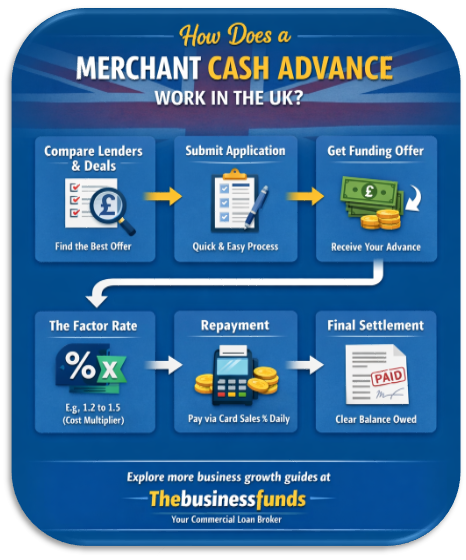
- Compare the Lenders and their Deals: First, you start the comparison of providers at Thebusinessfunds. Pick the lender that matches your business needs and provides the best factor rate.
- Application: You apply for a merchant cash advance through your selected company. It analyses your business performance, particularly your card sales of the last 3-6 months.
- The Funding Offer: The funding offer you get is generally determined by your average monthly turnover. For example, suppose your turnover is £20,000 monthly in card sales. You may get an advance of around £15,000 to £25,000.
- The Factor Rate: The merchant cash advance direct lender applies a factor rate like 1.2 or 1.3. It decides the total amount you will repay.
- Repayment: The repayment works through a process. Your customer taps the card at your terminal every time, and a small repayment percentage is automatically transferred to the lender. The percentage revolves around 10% to 20%.
- The Final Settlement: You need to continue paying until the final agreed amount is settled. It means there is no last date. If you have slow sales in a month, you pay less. If you have bumper business like during Christmas, you pay it early.
How is the calculation of the Merchant Cash Advance Cost done?
You usually don’t expect figures like 9% or 10% interest rate. In its place, you will see a factor rate. You can use this formula to calculate the total cost of your cash advance in the UK:
Total Repayment = Advance Amount × Factor Rate
Let us understand with an example:
Suppose you are running a café. You need £10,000 to purchase a new espresso machine.
| Advance Amount | £10,000 |
| Factor Rate | 1.25 |
| Repayment Percentage | 10% |
According to the formula (Total Repayment = Advance Amount × Factor Rate), you will repay £12,500 in total. Suppose you make £1000 in card sales tomorrow, £100 will go to the lender, and you keep £900. If there is no card sale the day after tomorrow, you pay £0. Therefore, it is a financial solution that actually smooths your cash flow.
What is the difference between a merchant cash advance and a business loan?
All business funding options are different from each other. Similarly, business cash advances are also available in 2026 with different features from traditional business loans.
| Feature | Merchant Cash Advance | Traditional Business Loan |
| Approval | 24 – 48 hours | 2 – 6 weeks |
| Repayment | Flexible % of sales | Fixed monthly instalment |
| Collateral | Usually an unsecured funding option | Secured with Property or Assets |
| Credit Score | Acceptance to any credit score or based on sales | Strictly preferred for those businesses with good credit scores |
| Cost Criteria | Fixed Factor Rate | Interest rate or APR |
| Early Repayments | Usually no discount | Possibility is there with interest savings |
Merchant Cash Advance with No Credit Check: Is it Possible or a Myth?
Most small businesses search hard for a merchant cash advance with no credit check. But it is only a MYTH. Let’s be honest: generally, responsible merchant cash advance direct lenders will conduct a credit score check.
Still, they may not need a perfect credit score. It is because the funding is protected against your future card sales. Therefore, your current business performance is preferable over the past credit issues. Lenders want to analyse the consistency in the type of business you are doing and earning stable revenue.
Technically, it may not be a “no credit check”, but it is more “client-friendly” than a bank loan due to a soft credit check initially.
Does applying for a cash advance affect your credit score?
As mentioned above, a soft credit assessment may be done. Consequently, it may not affect your credit score. Nevertheless, some credit providers may report it to credit agencies once you receive the funding. Therefore, you need to be clear with merchant cash advance lenders on their credit score policy.
What are the pros and cons of business cash advance loans?
Here is the sincere analysis of the possible advantages and disadvantages:
| Pros | Cons |
| You usually get an instant decision and funding offered in your bank account or within 24 hours. | The factor rate is often more expensive than a low-interest secured business loan. |
| There is no fixed minimum monthly payment burden. If sales are low, your payment is also low. | You won’t get any benefit, like an early payment facility. |
| You are not required to put your property or asset at risk, as these are unsecured funding sources. | If your business has 90% cash transactions or B2B invoices, then this financing solution is not for you. |
Which are the Best Industries for Merchant Cash Advances?
MCAs are more suitable for businesses that deal in regular debit or credit card payments. They have also experienced seasonal or variable revenue. In addition, the monthly card turnover should typically be £5,000 – £10,000+.
Here are the best industries for merchant cash advances:
- Retail (Clothing stores, electronics, online retailers)
- Hospitality and Food (Restaurants, pubs, cafés, bars)
- Hotels, Travel and Leisure (Hotels, travel agencies, resorts, event venues)
- Beauty and Wellness (barbershops, Salons, spas, gyms,)
- E-commerce & Online Businesses (Shopify stores, Amazon sellers, D2C brands)
- Wholesale & Small B2C Services (Garages, Small distributors, repair shops)
- Health & Small Clinics (physiotherapy centres, Dental clinics)
MCA is a short-term funding source where repayment is largely based on credit card revenue to access funding. It does not depend on invoices and contracts.
Top Merchant Cash Advance Companies in the UK
The UK market is well-embellished with funding options in 2026. You can go through a reliable broker to find out the best among merchant cash advance direct lenders.
Given below are the top UK lenders to consider for MCA:
| MCA Provider | Specialities |
| Liberis | Major company partnered with payment processors such as Barclaycard. |
| 365 Business Finance | Popular for higher acceptance and no hidden charges. |
| Tide | Provide funding options directly through the business banking app. |
| YouLend | Known for e-commerce and growing retail businesses. |
Suggestion: Approaching a broker to get the best merchant cash advance direct lenders can help you compare multiple repayment terms at one go.
Want to know more? Learn here how to get business funding in the UK quickly.
Frequently Asked Questions (FAQs)
Let us solve more of your queries:
- Can I get a cash advance if I do not have much trading history?
Most merchant cash advance lenders need at least 3-6 months of trading history to illustrate their overall business performance.
- My card machine has broken. What will happen?
Remember, your repayment is linked to processing. It means if your machine breaks, you do not make any payment. However, you will be breaching the contract if you intentionally do so.
- Will the lender charge any hidden fees?
You need to be careful on this part as some lenders charge extra, but do not reveal it. Therefore, while comparing merchant cash advance direct lenders, check any origination fees or processing fees in the initial offer.
- Can a business get more than one advance?
Generally, you need to pay at least 80% of your ongoing advance before you can apply for a merchant cash advance again.
Conclusion
You need to think of a merchant cash advance as your business partner that takes only a small part of your revenue. Most UK small businesses are looking for speed and flexibility rather than the higher costs related to the factor rate.
Focus on steady card sales and monthly card turnover to get a merchant cash advance in the UK. Decide how much funding you can require today and compare the deals. Fulfil all your business needs to reach the next level.

Lee Copper is an experienced financial content specialist helping businesses explore the UK loan market. He writes guides led by experts on business loans and finance products. His work follows strict editorial values to ensure reality, applicability, and simplicity for readers to make well-versed financial decisions. Lee creates in-depth guides backed up by research, industry best practices, and the latest market developments.


