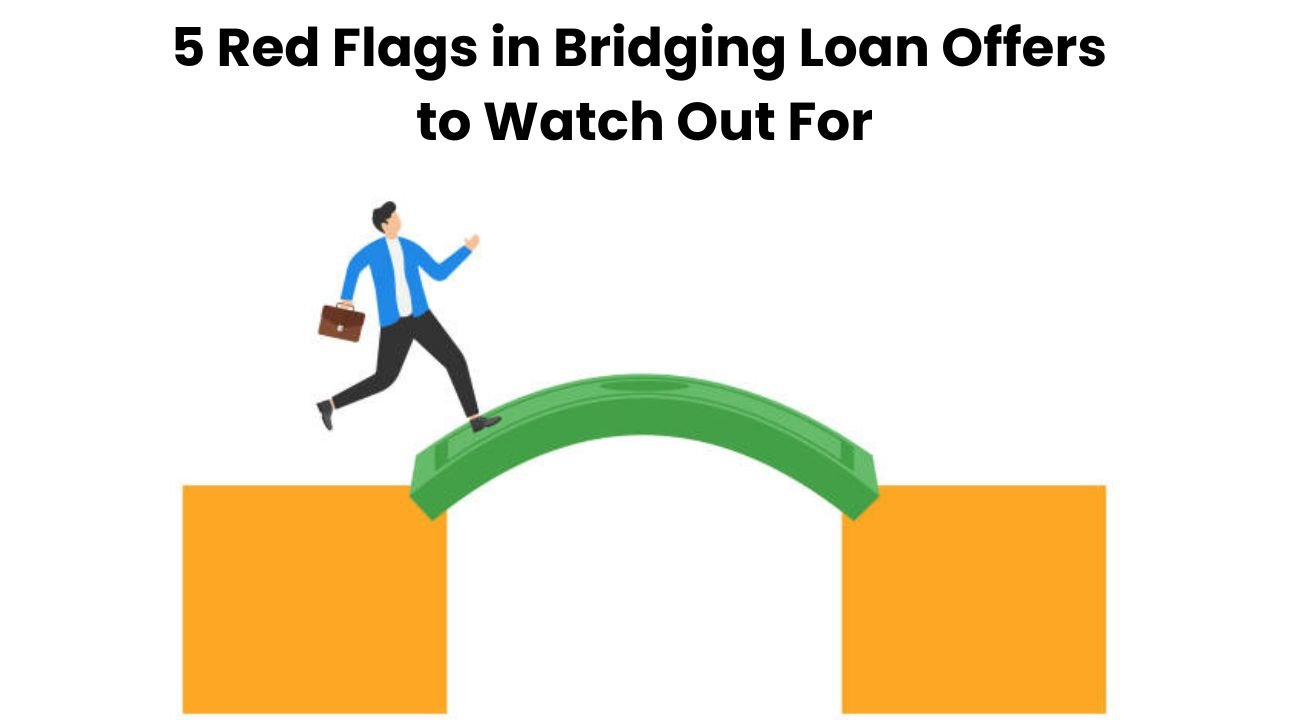
A bridging finance arrangement helps you to plug the gap between purchasing a new property and selling an existing property. Funds from a mortgage take time to reach you, while the property has not been sold. In this situation, this funding solution can arrange funds as soon as possible.
If you are in between buying and selling business properties, there are options to explore. You can apply for commercial bridging loans in the UK. Covering any short-term cash gap for the time being can be achieved with the help of this financing option.
This is the period when a business owner is waiting to receive longer-term finance to secure a property for the venture. These loans offer two unique features, i.e. speed and flexibility. This can make you forget to watch out for a few aspects.
When you do not review these pointers, an attractive loan offer can turn out to be expensive. It can even seem difficult to manage when repaying loans. For this reason, reviewing the essential red flags will be non-negotiable when you are opting for bridging loans.
5 red flags to scrutiny before accepting bridging loan agreement
Prior to considering bridging loans, you must not only assess how they can be useful. At the same time, it is crucial for you to understand the major red flags that will accompany this financing option.
- Interest rates might be deceptive
Do not fall for the advertised low rates, as the actual cost might be different. This is because these might be generalised rates, while the rate you get will be decided based on your financial situation and affordability.
Moreover, these rates alone do not constitute the total cost of borrowing. There might be additional components like processing fees, etc., which should not be overlooked. A bridging loan is a short-term financing option, and you must consider a few things.
- These loans might carry interest rates charged monthly rather than annually
- The quoted rate is whether simple or compound interest
- The rate may vary depending on the LTV (loan-to-value)
- You need to check if the rate depends on your situation
- Fee structure being unclear
Bridging finance arrangements will include different types of fees and charges. If there is something that has not been mentioned or is unclear in the cost structure, consider it a warning sign.
You need to keep an eye on how much has been charged as arrangement fees, valuation fees, legal costs, administration fees, exit fees, etc. If you do not pay attention to what has been charged, you may receive less funding. This is because some of the fees might have been deducted from the borrowed amount.
As a result, you will receive a reduced amount after the deduction of these charges. However, you will still be responsible for repaying the amount you have agreed to borrow despite receiving less funding.
- What can be done in this situation?
- Ask for a complete breakdown of the cost structure
- Enquire about anything which is unclear to you
- Get clarity about the amount you can expect to receive
- Step back if the lender or the broker fails to provide an explanation
- Ask them to clarify everything in writing
- Unrealistic exit strategy
One of the most crucial parts of borrowing is how you intend to pay back loans. Availing temporary funding through bridging finance may be possible. However, when it comes to demonstrating the right strategy on how to repay them, things might turn out to be confusing.
The probable exit strategy could be selling the existing property, refinancing onto a mortgage, or arranging funds via a different means. Therefore, you can clearly see that options are multiple, while a clear path is missing.
When getting a loan, you might not have clarity about the actual time when the sale of the property happens. Instead of getting sold within six months (as expected), it can take nine months. Therefore, if you have been thinking of using the money obtained after the property is sold to repay loans, you will get stuck midway.
The solution could be to think about what you can do if the expected options do not work out. A plan B should always be in your mind so that repayments do not get delayed at any cost.
- Default charges and consequences
Bridging finance may be easy to obtain if your business is able to qualify according to the lender. With a finance broker, the process can become easier. However, this should be your criterion when choosing this financing option.
You must analyse the consequences you will have to face after missing a loan payment. There might be late payment charges, which can add up and increase the overall borrowing cost. Besides, you might have to accept a bunch of fees like for extension, for legal consultation, elevated arrangement fees, etc.
Getting a loan extension might not be as easy as paying extra interest for additional months. You might have to bear the burden of accrued interest or other fees, which are typically levied when loan payments are missed.
You must read the loan fine print carefully to understand what can happen if repayments get delayed. Check if there might be situations when the lender can take certain actions against you and your business. It would be better for you to discuss with a legal consultant if you have any confusion.
- An urgency to accept the offer might be created
You might feel a constant pressure to go ahead with the offered proposal. Be alert if you are being told to sign the agreement, claiming that the offer has been made available for a limited period.
Think twice if enough time is not allowed to review documentation and carry out various verifications. Be a responsible borrower and allow yourself the time to research and analyse. Some commercial terms need to be understood carefully.
The meaning of getting fast finance is not making rushed decisions. Pay attention to cross-check again and again if someone claims to provide guaranteed approval.
The bottom line
If you are not convinced by the idea of getting bridging finance, you can check out a few alternatives. You can try getting business loans secured against property. Here, you will be using the property you want to purchase as security to draw out the necessary amount of cash.
Since an asset is involved, you can obtain a larger amount. Figure out how much you need to refurbish the property or to manage short-term funding gaps, etc. Then, decide the amount you should apply for after carefully assessing the repayment terms and rates.
FAQs
Are bridging loans more expensive than mortgages?
Yes, they can be. These loans are meant to serve any short-term purpose. For this reason, they may carry high rates of interest, as compared to mortgages, which involve an asset. Most importantly, the second option can be obtainable at larger amounts.
Should I choose bridging loans based on low-interest rates?
This should not be the only aspect on which a borrowing decision should be based. Calculate the overall cost of borrowing that includes interest rates, arrangement fees, valuation costs, etc. You will even get an idea about the potential cost of extension.
Can I repay bridging loans early?
You need to ask the lender to find out about early repayment charges. Some of them may levy additional fees, while others may allow you to pay back without any additional cost.

Harry Kane is a financial writer and author who has covered wide topics related to business loans and finance for the last decade. He has been working as the Chief Contributor in finding out deals on various business finance products covered by Thebusinessfunds, a reputed business loan broker firm in the UK. The primary work of Harry is to analyse the loan requirements of various businesses according to their circumstances and affordability. He directly communicates with the loan aspirants and guides them to get the right loan matching their needs. He has a vast experience in finance writing, working with many major business firms in the UK. At Thebusinessfunds, Harry also used to write well-researched blogs covering the financial problems of business loan aspirants and providing relevant solutions. He is a postgraduate with MSc. in Banking and Finance.