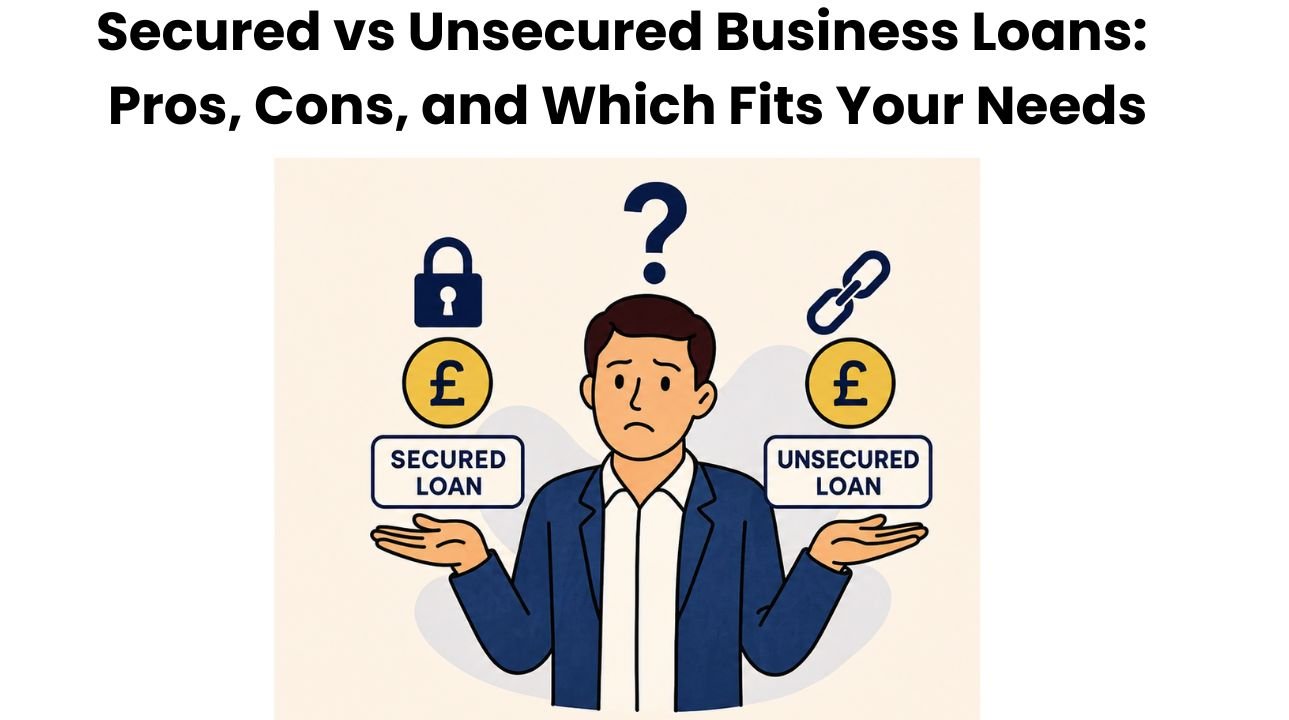
Whether it is a small business or a large established enterprise, everyone needs business financing for survival. It is used for business expansion, technology upgradation, and to remain competitive. Many types of business loan options are available, but first of all, a business owner has to decide whether they need a secured loan or an unsecured loan.
If you also own a commercial entity, then you must have also faced this confusion. However, the solution is very easy. It depends on factors like your funding requirement, business credit profile, and available assets. But before taking the final decision, it is important to know the difference between the two. Here is a guide for the same.
What is a secured business loan?
Secured business loans in the UK are collateral-based borrowing options. To obtain funds through this loan, you have to pledge a commercial asset, such as commercial property, inventory, machinery, business vehicles, fixed deposits, and sometimes even residential property.
If you do not pay your loan on time, then the lender can claim your asset. In that case, you will lose your asset. Secured business loans are used mainly for large-scale projects, such as business expansion, purchase of commercial property, equipment purchase, large investment opportunities, etc.
What is an unsecured business loan?
Completely opposite to secured loans, unsecured business loans are collateral-free borrowing options. These are short-term loans, for which you do not have to pledge any asset. Loan approval is given after checking the affordability of the business, such as business revenue, business history, credit score, profitability, cash flow, and recent payment record.
The rate of interest of these loans is high, but due to tailor-made deals available, repayments are affordable. These loans are mainly taken for short-term purposes, such as fulfilling the requirement of working capital. Apart from this, loans are also used to fill seasonal cash flow gaps. Unsecured loans are majorly considered a dependable financing option for small businesses and startups.
What are the major differences between secured and unsecured business loans?
Both loans are completely different. This difference can be seen in many factors, such as:
Collateral
- Secured loans need collateral.
- Unsecured loans do not need collateral to approve loans.
Loan amount
- Secured loans have higher borrowing limits.
- Unsecured loans offer a lower borrowing limit.
Rate of interest
- Secured loans have a lower rate of interest due to the pledged asset.
- Unsecured loans have a higher rate as no collateral is there to secure funds.
Approval process
- Secured loans take longer to process due to the valuation of the asset you pledge.
- Unsecured loans get processed in a short time.
Risk level
- In secured loans, you may lose your asset in case of default.
- There is no risk of losing the asset, but the cost is higher.
Advantages of secured loans and unsecured loans
Here are the strong sides of both the loan options.
| Secured loans | Unsecured loans |
| Lower rate of interest | No collateral required |
| Suitable for big and established businesses | Suitable for start-ups and small businesses |
| Higher borrowing limits | Speedy application process |
| Bigger borrowing limit | Lower total cost with short tenure |
| Higher approval rate with high value asset | High approval rate with stable repayability. |
Disadvantages of secured and unsecured loans
Now comes the other side of the coin that shows several weak points or challenges of both the borrowing options.
| Secured loans | Unsecured loans |
| Cannot borrow funds without collateral | Higher rate of interest increases the borrowing cost. |
| Risk of losing asset in case of default | Hefty instalments due to higher cost |
| Lengthy loan process delays approval decision. | Limited borrowing amount useful only for small needs |
| May affect future loan approval chances for a long time. | Lower approval rate in case of weak repayment ability. |
When should you choose secured loans?
You can choose to borrow through secured borrowing if –
- You have an asset to pledge as collateral
- You have a long-term need like business expansion
- You want smaller monthly instalments
- You want a lower rate of interest
- You can bear the risk of pledging an asset
When to choose unsecured loans?
Choose to borrow using unsecured loans in case –
- Your financial need is short-term
- You don’t have an asset to pledge
- You want to process the loan faster
- You have an asset, but you can risk losing it
- You want the debt to end in a short time
- You can pay high interest rates
- You have a strong repayment plan
Conclusion
You are always able to choose the best option if you focus on your needs. Also, it is vital to scrutinise your repayment ability. It helps make the right choice. Always keep these two factors in focus, and you can pick the suitable loan option.
Both secured and unsecured loans are useful. Usually, for recurring needs, unsecured borrowing is used for business bridging loans in the UK. While for needs that are less frequent, like once a year, choose collateral-based borrowing.
FAQs
Can I apply for an unsecured business loan after rejection?
You can apply, but approval is always subject to an affordability assessment. Also, a loan decision, whether approval or rejection, appears on the credit report in a month. Hence, until that is visible, you can apply with a provable repayment ability.
What if my asset value does not match the loan amount I need?
In that case, the lender approves an amount as per your asset value. You can decide whether you want to take the loan or not.
Can I switch from a secured or unsecured loan?
No, it is not possible typically. Both are different, and secured borrowing needs collateral. Hence, technically it is not possible.

Harry Kane is a financial writer and author who has covered wide topics related to business loans and finance for the last decade. He has been working as the Chief Contributor in finding out deals on various business finance products covered by Thebusinessfunds, a reputed business loan broker firm in the UK. The primary work of Harry is to analyse the loan requirements of various businesses according to their circumstances and affordability. He directly communicates with the loan aspirants and guides them to get the right loan matching their needs. He has a vast experience in finance writing, working with many major business firms in the UK. At Thebusinessfunds, Harry also used to write well-researched blogs covering the financial problems of business loan aspirants and providing relevant solutions. He is a postgraduate with MSc. in Banking and Finance.