
What Is Revenue-Based Financing and How Does It Work in the UK?
In the current business scenario where there is financial uncertainty along with opportunities for businesses, revenue-based financing is becoming increasingly popular.
This is an affordable and practical option to borrow funds based on future sales revenue. Therefore, several business types like e-commerce businesses, start-ups and SaaS companies prefer it.
Fulfil one simple condition of good sales performance and get revenue based financing online.
Quite different from traditional loans, the RBF model depends on the sales performance of the business. This is much more liberal than the traditional method of giving loans, which is based on credit histories and collateral.
Here is a guide on revenue-based financing with relevant facts that authenticate the reasons for its dependability.
What is revenue-based financing?
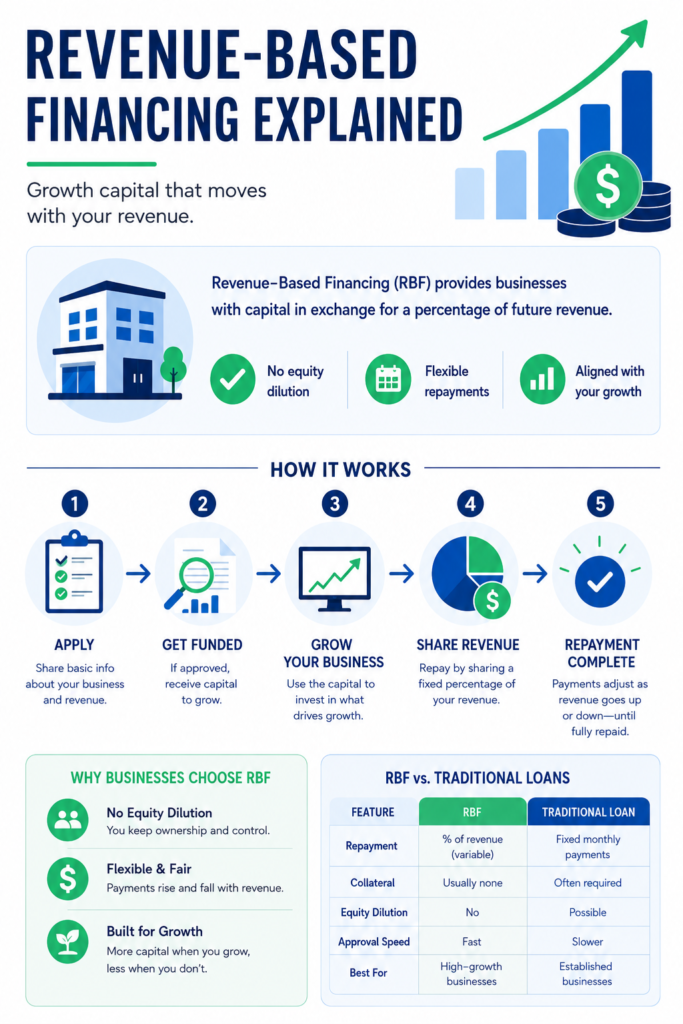
Revenue-based financing is a business financing option. In this, lenders or investors lend a business a percentage of its future revenue as a loan. Repayments are based on sales performance.
The repayment amount increases with high sales, while a smaller amount is paid in case of low sales. Therefore, it is considered among the best ways to get instant business funding in the UK.
The amount to repay is calculated as per the factor rate. It is typically written in a decimal figure such as 1.1, 1.25, or 1.4. To calculate the total repayment amount, multiply the borrowed amount by this factor rate.
Formula = Total amount to be repaid = Loan Amount X Factor Rate.
- Example as per 1.1 Factor Rate
Revenue-based financing through a detailed example
Take a look at how the financing choice works when a business avails itself of funds based on sales.
| Feature | Example |
| Funding received | £50,000 |
| Factor rate | 1.1x |
| Revenue share | 7% |
| Total repayment | £55,000 |
| Monthly revenue | £40,000 |
| Monthly repayment | £2,800 |
As per formula – £50,000×1.1 = £55,000
You can also apply for a soft check revenue based finance quote. It helps to compare lenders without leaving search footprints on the credit report.
How does revenue-based financing work?
The application process is simple and speedy, with fewer formalities required, unlike traditional business loans.
• Application – Apply to an RBF lender with the following documents. Many lenders review real-time business performance through open banking technology.
- Bank statement
- Monthly revenue
- Accounting data
- Payment processor data
- Sales trends
• Funding offer – Once approved, the lender gives an offer with an advance amount and mentions a revenue share percentage. A repayment cap is also a vital element in the offer. The offer has its terms and conditions as per the business’s sales performance.
• Get funds – once the borrower accepts the offer, the lender sends the amount to the borrower’s bank account.
• Revenue-based payment – The lender collects the repayments either weekly or monthly, until the decided amount is paid back.
Types of revenue-based financing
There are mainly two types of affordable revenue based financing in the UK,depending on the financial circumstances of a business.
• Merchant cash advance (MCA) – In this option, a business borrows capital as per card sales. Instalments are taken from daily credit or debit card transactions.
• Revenue advance – In this type of funding, funds are approved according to the overall revenue of the business.
Both types of financing are useful for specific types of businesses. Merchant cash advance is usually used by hospitality businesses, retailers and restaurants. While revenue advance is usually online companies and SaaS companies use it.
Features of revenue-based financing
The following features of this business financing model make it a practical choice for commercial entities.
• No loss of equity
Business owners do not have to lose their equity to get a loan. A relieving option for businesses.
• Flexible repayment structure
Repay as per business sales only. No pressure to pay any fixed instalment makes it a flexible repayment business finance.
• Suitable for multiple business types
From digital businesses to hospitality businesses, this financing choice is useful for all types.
• Fast approval process
Funds are approved as per business revenue and not credit histories. Hence, the approval process is speedy.
• No collateral required
No asset has to be pledged to borrow funds. Enjoy risk-free borrowing with unsecured revenue-based financing.
Facts and Figures as per UK-based Revenue-Based Financing
A statistical insight helps understand the significance and utility of the financing product.
• UK RBF providers offer funds up to £10 million.
• Repayment caps on RBF usually range from 1.1x to 2x.
• Revenue shared considered by lenders is from 5% to 25%.
• Funding approval usually takes 24 to 72 hours.
• Fintech RBD lending is growing fast due to the high demand for alternatives.
• E-commerce and SaaS businesses have the bigger user share of RBF funding.
Advantages and disadvantages of RBF
Know both sides of the coin to make an informed decision. As per business type, it is easier to relate to the funding type.
| Pros | Cons |
| Improved cash flow flexibility | Higher overall cost as compared to traditional loans. |
| No fear of losing ownership | Consistent revenue required for approval |
| Speedy access to funds without collateral | Ongoing revenue deductions affect business cash flow |
| Credit score does not affect approval decision | Limited funding amount as per sales revenue |
| Good option for established businesses | Not suitable for businesses with seasonal income |
Challenges businesses usually face
Be prepared to handle the challenges below. Plan solutions to ensure a predictable borrowing journey.
• Seasonal revenue fluctuation management
• Selection of the wrong funding type
• Taking repayment cost low
• Struggle to get approved with irregular cash flow
Tips Before Applying as per RBF lenders in the UK
The following ways are suggested by RBF lenders to apply safely and get approved.
• Keep revenue records updated – It is the base of the funding application process and approval decision. Keep the records updated with the latest details.
• Compare multiple providers – Never rush to get a deal with the first lender that sends its offer. Alwayscompare revenue based financing companies for a rational decision.
• Improve cash flow – Irregular cash flow is a strong reason for lenders to reject a loan application. Make sure, it is regular and as per lending requirements of lenders.
• Avoid over-borrowing – RBF facilitates smooth and fast funding. Don’t let it become the reason to overborrow. This option is expensive, hence repaying can be difficult.
• Understand the total cost – Knowing the total cost is important before accepting the agreement. It is a safe way to keep future cash flow unaffected.
Therefore…
Considering all the facts, it can be concluded that therevenue-based finance for limited companies is a useful funding option. The best part about RBF is that it is a straightforward financial product.
Good business sales revenue means easy approval. Yes, the cost can be higher than conventional loans. But flexible eligibility criteria and timely funding make the revenue-based model a last-minute saviour.
FAQ’s
Is revenue based financing a better option than bank loans?
Yes, it is, especially if you are looking for urgent funds with flexible affordability conditions. This funding model is not as stringent as bank loans, which are affected by credit ratings.
Can a start-up business get RBF?
Yes, startup revenue based financing is available. But the business needs to fulfil the conditions of regular cash flow and good sales performance. Start-ups usually struggle with these aspects; apply wisely.
Are early repayment options available in revenue-based financing?
Some lenders may allow that, but extra fees and charges may apply. Always check it with the lender before applying.
Can I avail funds with a bad business credit rating?
Yes, bad credit revenue based financing is available. But the factor rate and repayments can be higher.
Is RBF only for online businesses?
No, both online and offline businesses can avail funds if they have a regular and dependable sales performance.

Lee Copper is an experienced financial content specialist helping businesses explore the UK loan market. He writes guides led by experts on business loans and finance products. His work follows strict editorial values to ensure reality, applicability, and simplicity for readers to make well-versed financial decisions. Lee creates in-depth guides backed up by research, industry best practices, and the latest market developments.


