
Merchant Cash Advances vs Unsecured Business Loans: A Clear Comparison
Merchant cash advances and unsecured business loans are aimed at funding business expenses when cash is tight, but they are both fundamentally different in how they are structured and assessed. The right choice hinges on your creditworthiness, financial stability, and above all, business model.
A general comparison between merchant cash advances and unsecured business loans:
| Features | Merchant cash advances | Unsecured business loans |
| Speed | Fast (between 24 hours and 72 hours) | Slow (it takes a couple of days) |
| Eligibility | Based on debit and credit card sales | A strong credit history and income are required |
| Cost | A factor rate decides the total cost | An annual percentage rate decides the total cost. |
| Repayment term | Variable (based on sales amount) | Fixed (irrespective of profitability) |
| Suitability | Businesses with high card transactions | Businesses with a cash flow stability |
What is a merchant cash advance {MCA}?
A merchant cash advance in the UK is a funding method that enables you to borrow a sum of money against the projected debit and credit card sales. Instead of paying it back with interest, you pay a fixed percentage of the everyday sales you make until the whole amount is discharged.
Your sales history serves as the basis for the assessment of the advance amount.
While unsecured business loans charge interest rates, MCAs use a factor rate to decide the total cost of the loan.
The factor rate is a fixed multiplier applied to the advance amount. For instance, if a £30,000 advance is decided based on your previous card sales and the factor rate that your lender applies is 1.5, the total amount of money you will pay back is:
£30,000 x 1.5 = £45,000
A fixed portion of your daily card sales will go towards your lender, which is decided by the split rate ranging between 5% and 20%.
Some market insights about the MCA
According to research, the merchant cash advance market is experiencing unprecedented growth, driven by the rapid expansion of small businesses and quick access to funds. The MCA market size in 2026 is estimated at $22.17 billion, up $2.5 billion from 2025. The market size is expected to grow by 7.3% by 2035.
The rapid growth in the MCA market should be attributed to the dominance of the retail and ecommerce sector. Rapid digitisation, cash flow fluctuation, and a high volume of card transactions are three responsible factors for making the MCA the most suitable funding for both sectors.
What are unsecured business loans?
Unsecured business loans enable you to borrow a fixed sum of money that you pay back to the lender along with interest over a fixed term, which usually ranges between six months and five years.
They are known as unsecured as they are collateral-free. It means there is no risk of losing business assets. However, some lenders will require you to give a personal guarantee. If your business fails to settle the debt, you will be personally obligated to do so.
How do unsecured business loans work?
- You borrow a fixed sum of money to be paid back over a fixed duration.
- Fixed interest rates are charged.
- Monthly instalments remain fixed. They include both principal and interest.
- Your affordability will be assessed before approval.
- Subprime borrowers are also eligible for these loans, but they end up paying high interest rates.
How do MCAs differ from unsecured business loans?
Now that you know the basics of merchant cash advances and unsecured business loans. Now you need to know how they differ from each other.
- MCAs vs unsecured business loans – repayment structures
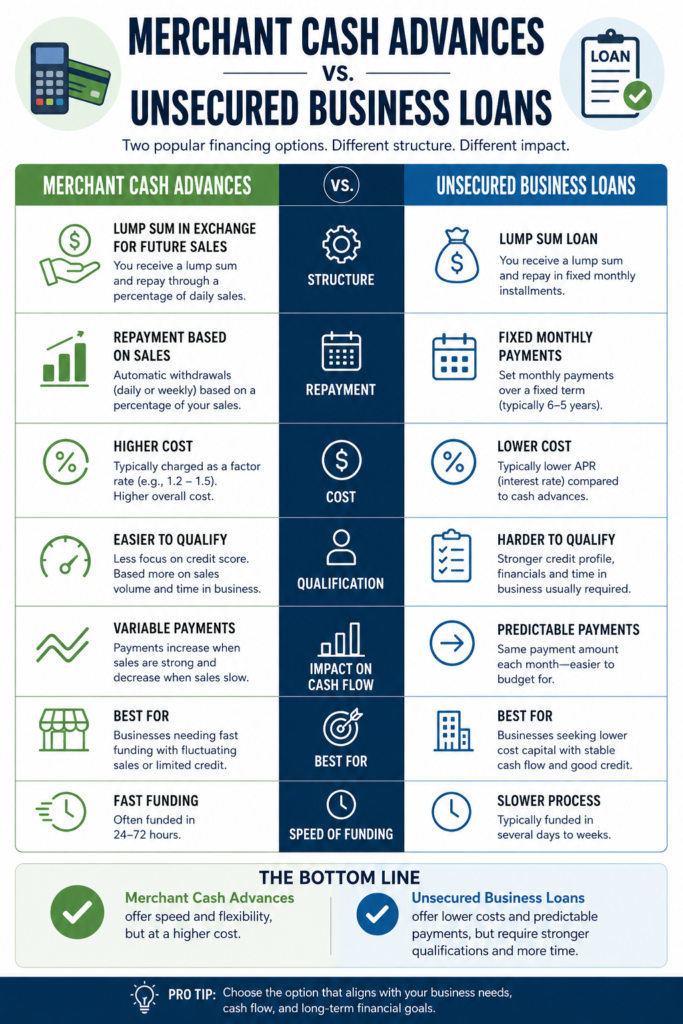
The repayment structure of MCAs and unsecured business loans is completely different.
| Merchant cash advances | Unsecured business loans |
| The factor rate decides the total cost of the loan to be paid back. | Interest rates determine the total cost of the debt. |
| Repayments are a fixed percentage of your daily card transactions. | Repayments are monthly instalments. Their size is predetermined. |
| The repayment amount will be flexible with sales, as it depends on the sales amount. | Repayments will remain the same irrespective of the sales amount. |
- MCAs vs unsecured business loans – approval criteria
Applications for both types of funding are processed differently.
| Merchant cash advances | Unsecured business loans |
| Your previous card sales will be the basis for the borrowed sum. | Your cash flow and profitability will serve as the basis for the loan size. |
| This funding is suitable for cafes. Pubs, retail businesses and ecommerce stores where card transactions are high. | This type of funding is suitable for service providers, self-employed, manufacturers, B2B and B2C firms. |
| At least six months of credit sales history is required. | At least one year of trading history is required, provided you have hit the breakeven point. |
| Neither collateral nor personal guarantee is required | Personal guarantee might be required. |
| No credit checks are made | You must have a good credit history. |
- MCAs vs unsecured business loans – early settlement and late payment charges
Unlike traditional business loans, merchant cash advances do not charge early repayment fees due to their repayment structure.
While using a merchant cash advance, you agree to pay a fixed sum of money (advance + fees) based on the factor rate.
A split rate decides how much portion of your sales will go towards your lender. If your sales volumes are high, you can repay the debt faster, but this will not reduce the total agreed amount.
In the aforementioned example, the total cost is £45,000. Whether you choose to pay above and beyond the split rate, the total cost remains unchanged. Early repayments help you save money where interest accrues over time.
If your provider allows you to make the payment beyond the contracted split rate, no early repayment fees will be applied. Likewise, there are no late payment charges as payments are flexible with sales. You might attract penalties when you fail to adhere to contract conditions.
However, early repayment fees are applied to unsecured business loans in order to reduce the interest loss to your lender. Early settlement is recommended only when it helps save you money despite paying early repayment charges. Late payment fees are levied when you make a default. This adds up the total cost of the debt.
Factors to decide if MCA is suitable for your business
Here are the factors to decide whether a merchant cash advance is suitable for your business:
- Are your previous card sales impressive? You can qualify for an MCA if you have a strong track record of card sales in the past.
- Do you accept payments through debit and credit cards?
- Do you expect strong monthly sales down the track? Slow sales will take a long time to discharge the debt.
Factors to decide whether unsecured business loans are suitable for your business
Here are the factors to decide whether unsecured business loans are suitable for your business:
- Do you have a strong credit rating?
- Have you started earning profits? Is there consistent growth in your revenues?
- Is cash flow stable? Cash flow instability often leads to repayment difficulties.
- Are you comfortable with a loan term? Loans with longer payment terms cost more interest in total.
The bottom line
Merchant cash advances and unsecured business loans are completely different. The option you need to choose depends on your business model and needs. When taking out an unsecured business loan, make sure the lender is registered.
Watch out for outlandish claims such as “best unsecured business loans”, “guaranteed approval”, and the like. No matter how affordable a loan deal is, it can trap you into an ongoing cycle of debt if you fail to manage it responsibly.
FAQs
- Which option is cheaper: merchant cash advances or unsecured business loans?
Merchant cash advances might be more expensive than unsecured business loans, as the factor rate is applied to determine the total cost of a loan. However, unsecured loans could also prove to be too expensive if your creditworthiness raises concern about your repayment potential.
- Which type of loans is popular among start-ups: MCA or business loans?
Trading history is a must to qualify for both types of loans. Unsecured business loans require at least one year of trading history, and MCAs demand at least six months of trading history. If your business is not old enough, consider applying for start-up business loans.
- What are the alternatives to a merchant cash advance?
In order to access instant funds, you can apply for a business line of credit, invoice financing, or business overdrafts. However, understand the pros and cons of all these options.
- Can I have an MCA and a business loan at the same time?
Yes, you can, but bear in mind that the cost of unsecured loans is determined based on your existing debt-to-income ratio and cash flow condition. An existing MCA can lead to a reduction in cash flow. Lenders will perceive you as a risky borrower. As a result, they will charge high interest rates.
- Which one should you take out if you are eligible for both: unsecured loans or MCAs?
The decision depends on the following factors:
- How fast do you need money?
- How strong your credit score is
- How much do you need?
- How predictable is your income?

Lee Copper is an experienced financial content specialist helping businesses explore the UK loan market. He writes guides led by experts on business loans and finance products. His work follows strict editorial values to ensure reality, applicability, and simplicity for readers to make well-versed financial decisions. Lee creates in-depth guides backed up by research, industry best practices, and the latest market developments.


