
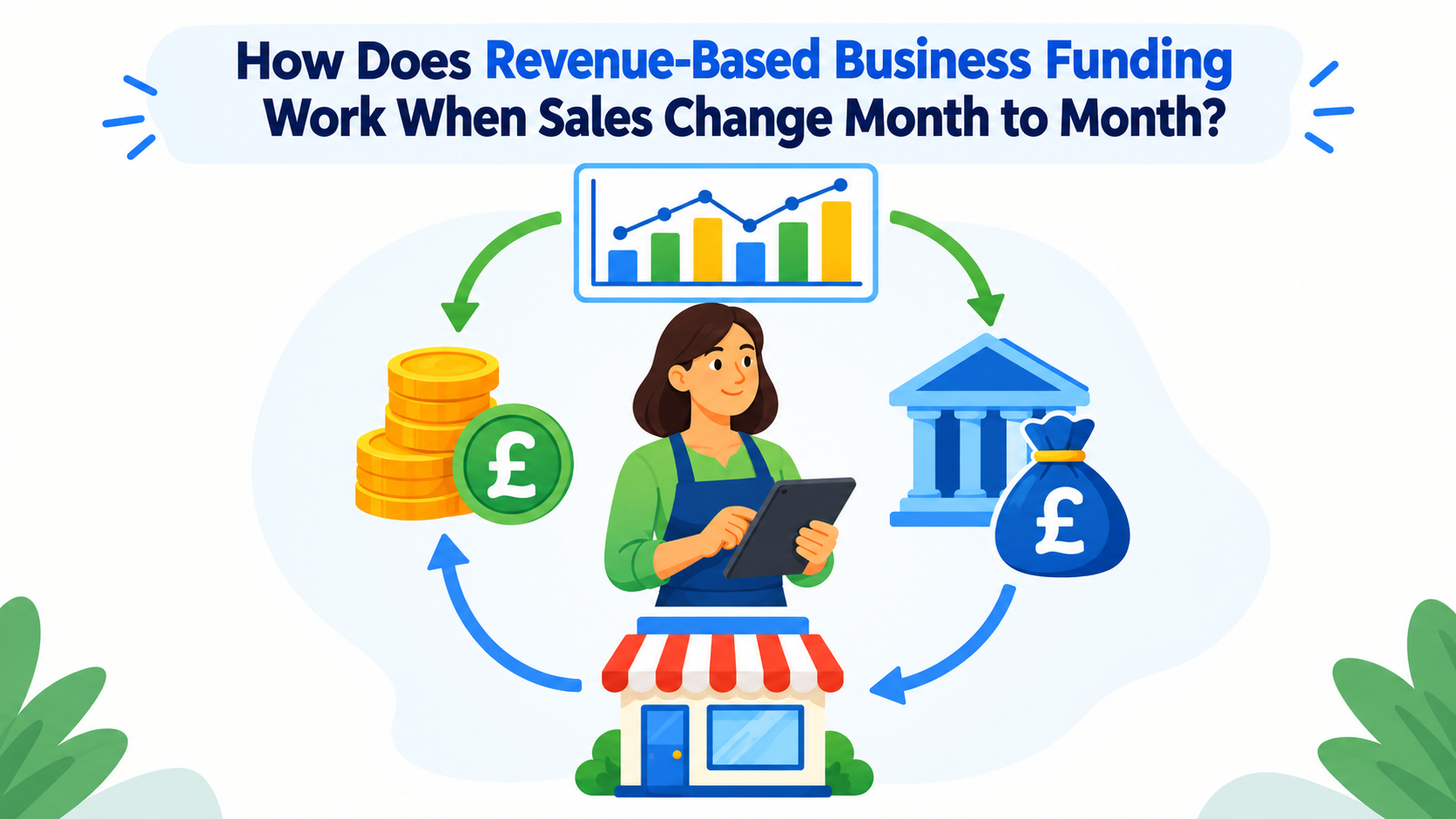
How Does Revenue-Based Business Funding Work When Sales Change Month to Month?
Revenue-based business funding (RBF) is a more agile and resilient alternative to traditional business funding. Small and medium enterprises work in an increasingly unpredictable economy. They need a financing solution that adapts to their revenue patterns. Traditional loans come with rigid repayment plans that leave SMEs with little cash to meet their day-to-day operations. Here comes the role of RBF.
What is revenue-based business funding?
Revenue-based funding is a financing model where repayments are tied directly to your business’s revenue. Instead of fixed monthly instalments, you repay a percentage of your sales until the agreed amount is fully paid back.
You will pay more when your sales are high, and you will pay nothing when sales are zero. The most common benefits of RBF include:
- No fixed repayment schedule
- No equity dilution
- Aligned repayments with your sales
RBF model is particularly suitable for businesses with variable income, such as ecommerce, hospitality and retail.
How does RBF work?
It is vital to check your eligibility. Your business must have been trading for at least a year and have already reached the break-even point. If you meet the eligibility criteria, you will receive a lump sum of money at a factor rate instead of an interest rate.
You will pay back the total cost at a split rate, which is a fixed percentage of your sales. Payments will be made until the whole amount is paid back. Early repayments cannot benefit you, as the factor rate remains unchanged throughout the term.
Since a fixed percentage of sales is to be made every day or week, repayments continue until the whole amount is paid back. There is no fixed timeline.
Factor rate – it is a multiplier that is applied to the borrowed sum to determine the total repayable amount. It typically ranges between 1.1 and 1.5.
Split rate – it is a holdback rate that is applied to your revenues to calculate the repayment amount per day or week. It can range between 10% and 20% depending on your overall financial condition.
What are the types of revenue-based funding?
The following are the types of revenue-based business funding:
- A merchant cash advance
A merchant cash advance is an ideal solution for retail and ecommerce businesses. You should have a large volume of card sales in order to be eligible for a merchant cash advance. Payments will be automatically deducted every day or week until the whole amount is paid back.
A flexible merchant cash advance for UK small businesses can prevent you from running out of cash to meet day-to-day operations. Those who rely on debit and credit card sales may struggle to qualify for traditional loans.
Although there are short-term working capital loans for seasonal businesses, you still need a considerable and consistent cash flow to be eligible for them. SMEs from ecommerce, retail and hospitality industries might struggle to meet the strict criteria for working capital. Fortunately, a merchant cash advance can come in handy.
- Revenue recurring financing
This financing model has been designed to help businesses with predictable subscription or contract-based income, such as gyms or similar membership-based businesses.
Money is lent based on your monthly recurring revenue. Repayments are usually a fixed percentage of your monthly recurring revenue. You will continue to make payments until the whole amount is paid back. A merchant cash advance involves daily payments from your card sales, but RRF involves a fixed percentage of monthly recurring revenue.
Is invoice financing a revenue-based business funding?
No, invoice financing is security-based funding. Here, the collateral is unpaid invoices. Unlike traditional business loans, you raise money against unpaid invoices. You do not even have to have a good credit score, but invoice financing companies will run a background check on your customers.
Invoice financing is a suitable alternative only for businesses that use the invoice model. If you come across some large expenses or a good business opportunity crosses your way, you can have a lender finance about 85% of the unpaid invoice value.
You can use this money the way you want. The remaining invoice balance will be handed back to you after collecting payments from your customers. An invoice financing company charges fees instead of interest rates. Invoice financing is the cheapest financing solution.
What are the potential drawbacks of revenue-based financing?
Here are the potential drawbacks of revenue-based financing:
- They can be expensive compared to a traditional business loan, especially if revenues grow quickly in the months to come.
- Repayments require consistent cash flow. You might find it hard to get rid of the debt soon if sales are not high.
- Early-stage businesses might not be eligible to qualify for revenue-based business financing.
- Repayments will reduce cash flow, so it is crucial to ensure that you do not struggle to meet other day-to-day commitments.
The bottom line
Revenue-based funding is generally ideal for businesses with fluctuating income streams. Repayments are tied to your monthly sales, which helps you meet your day-to-day expenses smoothly. There is no fixed repayment schedule, and hence they provide the flexibility that you need to run your business.
Does your business need financing? Do not let irregular sales get in your way of growth. We can help you arrange the most affordable revenue-based business financing.
FAQs
- How much can I borrow through Revenue-based funding?
There is no fixed amount of money you can borrow. Funding largely depends on your revenue size. There is a possibility of borrowing twice the average revenue amount.
- RBF or Business Loans: Which is a smarter choice for eligible businesses?
If you are eligible for both revenue-based business funding and a traditional business loan, the better option depends on your business model and cash flow stability. RBF offers flexibility and aligns repayments with daily cash flow, while loans provide predictability and lower overall cost.
- How quickly can I access funds?
You can get approval within two or three business days. Lenders will assess your overall business situation before deciding on the loan amount.

Lee Copper is an experienced financial content specialist helping businesses explore the UK loan market. He writes guides led by experts on business loans and finance products. His work follows strict editorial values to ensure reality, applicability, and simplicity for readers to make well-versed financial decisions. Lee creates in-depth guides backed up by research, industry best practices, and the latest market developments.


