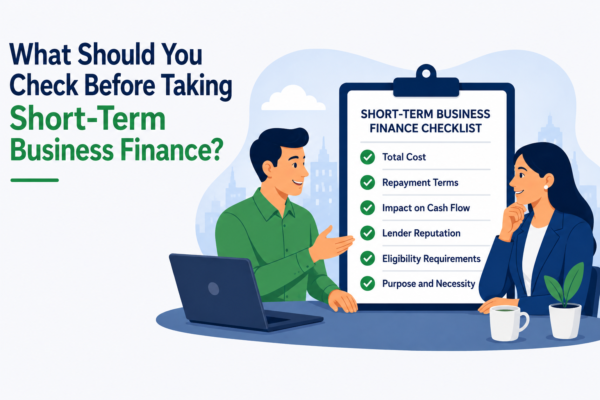
What Should You Check Before Taking Short-Term Business Finance?
Short-term business loans may help you cover immediate financial needs like updating stock, paying suppliers, payroll, etc. Choosing the right type is important, especially if you are taking one for the short term. While applying, check a few aspects.
It could be: how much you can afford to repay, APR, payable amount, lender’s industry expertise, and flexible repayment options. The checklist below may help you know certain aspects before applying for short-term business finance.
What to check before applying for short-term loans: Quick answer
Before taking short-term business loans in the UK for small businesses, you must analyse:
- Why do you need the funds, and whether you need them for the short term?
- Check the full cost of borrowing (including APR and interest rates)
- Whether repayments are affordable for you given your financial liabilities
- Whether the repayment fits the seasonal business flow
- Identify the repayment flexibility- weekly, monthly, fortnightly
- Whether a personal guarantee or collateral is needed
- The lender’s industry expertise, terms, and complaint process
- Alternatives that might cost less.
Let’s analyse these in detail:
- Define the funding gap
You must have a well-defined, measurable purpose to borrow money as a small business owner. Short-term loans are generally more suitable for bridging a gap with a foreseeable repayment source.
For example, you need to renovate an office property and can repay the dues from its sale. Similarly, you may borrow money against unpaid invoices, and the money goes to the lender immediately as the client pays. You must have a clear idea of what you want to borrow money for and how you will repay it. Precisely analyse:
- The exact amount needed
- What the money will pay for
- When the investment should generate cash
- What will happen if that cash arrives late
- Calculate the total loan cost
Most business owners commit the mistake of judging the cost of a loan by just checking the interest. However, it does not define the complete amount you are liable to pay on a loan. Instead, one must analyse the total amount, interest and other loan fees that you are supposed to pay. It gives you a clear idea of how much you should borrow.
It is generally advisable to get a complete breakdown of the costs from the lender. Check for:
- Interest or factor rates
- Arrangement fees, loan closure or drawdown charges
- Monthly account management fees
- Fees for missing a payment or defaulting on a loan
- Early loan settlement probabilities and rules
- Charges for loan renewals, refinancing, or term extension.
A shorter repayment term may mean lower interest costs. However, the monthly payments remain high in that case.
- Stress-test the repayment affordability
Build a simple cash flow forecast that covers the entire borrowing term. It includes sales receipts, VAT, payroll, office rent, existing loan payments, and suppliers’ dues. Now, stress-test it against the unexpected fall in business sales and revenue. Check what you will do if:
- A customer pays the dues late
- Your sales fall drastically and are below the projections
- You incur a huge loss; then how will you pay the dues
- Repayments and interest may increase, and you may get into a debt trap. How will you get out of this situation?
- Understand how repayment works
The repayment structure matters just as much as credit card sales. You may repay a short-term business loan in monthly, daily and weekly payments. Choose the structure that suits your finances and affordability the most.
Before repayments, confirm the following:
- Repayment frequency and exact dates.
- Whether payments are fixed or linked to the business turnover.
- Whether the lender can collect the payment directly from your bank account.
- Whether you can overpay or settle the loan early.
- What happens if you pay the dues late?
- Whether the agreement allows the lender to demand repayment early after a breach.
Match repayments to when your business actually receives money. Do not rely on the probabilities of getting cash/payments.
- Check personal guarantee requirements
Many lenders may demand a personal guarantee to reduce the risk. A personal guarantee is a formal document that grants the creditor permission to tap personal assets if the business owner cannot repay the dues from the company’s cash reserve.
A personal guarantee may also mean that a person/business partner may act as a guarantor to repay the dues if the primary borrower cannot.
Read any guarantee that’s separate from the primary agreement. Check:
- The maximum amount guaranteed.
- Whether interest, costs and fees are included.
- Whether the guarantee is capped or unlimited.
- Whether more than one director is jointly liable.
- Whether personal assets could be at risk.
- Whether independent legal advice is appropriate.
- Authenticate the lender
Determining the lender’s industry expertise, operating years, projects, and companies it has worked with and helped may help you decide right. It clears the confusion of whether the person can assist you with your needs. Do they share relevant industry experience?
Check the website and identify whether the lender exists. Analyse the official email, office address, and contact number. Pre-qualify to check whether they demand any upfront payment to provide a loan. Not every lender asks for one. Understand the conditions well and check whether you get clear guidance on the loan.
- Identify the alternatives
Short-term business loans may not be the only option. If it does not fit your needs, you may explore other options like:
- Asset finance: It helps you finance the business asset purchase without paying upfront
- Unsecured business loans: You may get unsecured business loans in the UK as a startup. It is a safer option if you fear pledging limited assets or lack any.
- Invoice finance: You may get cash against unpaid invoices
- Inventory finance: You may get the money against the existing inventory total value
- Secured business loans: It involves a huge payout against an official asset that acts as a loan security
- Long-term business loans: It grants you the flexibility to spread out payments into fixed but long-term instalments. The monthly payments remain lower on these loans.
Bottom line
Therefore, you must consider these aspects before taking a short-term business loan in the UK. Identify the loan purpose and the amount you need. Check your recent business growth and revenue. Identify whether you can repay the dues comfortably. Compare loan costs like APR, interest rates and total loan costs.

Lee Copper is an experienced financial content specialist helping businesses explore the UK loan market. He writes guides led by experts on business loans and finance products. His work follows strict editorial values to ensure reality, applicability, and simplicity for readers to make well-versed financial decisions. Lee creates in-depth guides backed up by research, industry best practices, and the latest market developments.