
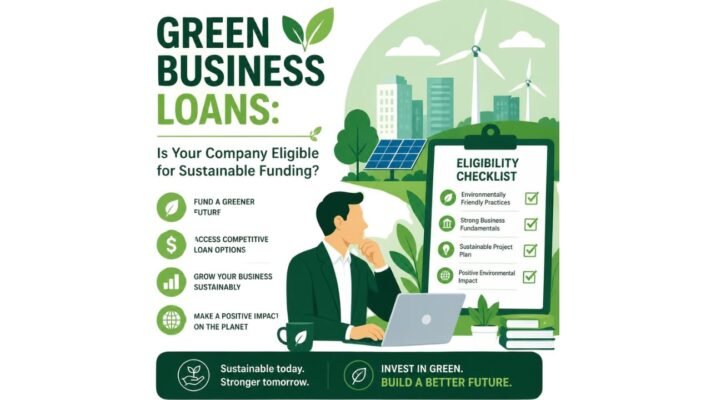
Green Business Loans: Is Your Company Eligible for Sustainable Funding?
Green finance refers to loans specifically designed for UK SME’s to finance renewable energy installations, energy efficiency upgrades, and waste reduction systems.
Green business loans are usually available at lower interest rates than other business loans. If your business is looking forward to a project that reduces carbon emissions, drops energy consumption, and improves environmental impact, a green business loan may help.
What is a Green loan?
A Green Business loan is a loan that supports environmentally friendly activities. It may include solar panel installations, environmentally friendly packaging, replacing plastic with reusable materials, reducing shipping emissions, etc.
Now, businesses are actively seeking processes to decarbonize operations. ESG and high power prices are also the major reasons behind the popularity of green loans.
It differs from standard business loans, as traditional business loans can be used for any purpose, whereas green business loans are specifically for environmentally friendly upgrades. Interest rates are generally lower on green loans if the project meets the sustainability goals and the asset criteria.
What projects can you cover with Green Business finance?
You may cover sustainable and environmentally friendly projects with green business finance in the UK. Here are some aspects that you may seek a loan for:
- Renewable energy systems
You can use green business finance solutions for ground-mounted arrays, wind turbines, and battery storage. These aspects help you save money on energy consumption. Also, you may start generating income by setting up SEG (Smart Export Guarantee).
- Improve energy efficiency
Double and triple-glazing windows, improving insulation, ventilation, air conditioning and LED lighting set-up upgrades may help you consume less energy.
- Switching to energy-friendly machinery
Some business owners might want to switch to energy-friendly machinery to save on electricity consumption, reduce carbon emissions, and improve production. It also improves the reputation of the firm.
Can you explain the latest example of how green finance may help in the UK?
A current, concrete example of a UK business benefiting from a green loan is Island Delight, a food manufacturer that used a £600,000 green finance facility from Lloyds Banking Group to fund solar panels and electric vehicles, explicitly to cut emissions and energy costs.
- Real example: Island Delight’s green loan
- Business: Island Delight, supplier of Jamaican patties and ready meals to major UK supermarkets.
- Loan:£600,000 invoice finance/green loan from Lloyds Banking Group.
- Use of funds: Installation of solar PV panels across its 15,000 sq ft manufacturing site in Hockley. Purchase of its first electric vehicles for its delivery fleet.
Context: The company already ran a zero-waste-to-landfill policy for 15+ years and used anaerobic digestion to generate energy from food waste; the green loan was the next step to decarbonise energy and transport.
How does a UK business typically benefit?
Based on current UK green loan products and case studies (including Island Delight the main benefits are:
- Lower financing cost: No arrangement fees and/or interest rate discounts for qualifying green projects
- Access to capital for high‑upfront projects: Solar, EVs, heat pumps and retrofits often have long paybacks; green loans make cashflows viable.
- Strategic positioning: Visible decarbonisation supports tenders, ESG reporting and resilience to tighter regulation.
- Tailored structures: Staged drawdowns, interest‑only build phases and repayment holidays suit retrofits and sustainable builds.
Conclusion
Island Delight used the loan to scale on‑site renewables and improve its fleet, cutting operational carbon and exposure to volatile fossil fuel prices.
Tying finance to specific green assets helped justify the investment internally as a long‑term sustainability and cost‑control strategy. It also improved existing credentials (zero‑waste, anaerobic digestion) with fundable upgrades aligned to customer and regulator expectations on supply‑chain decarbonisation.
Who may qualify for a Green Business loan?
You must meet the following conditions to get a Green Business loan.
- Basic business eligibility
- You must be a registered business (sole-trader/partnership/limited company) with a valid UK bank account.
- You must be actively trading for 12 months (according to the scheme/lender)
- The schemes and loan quotes may vary across England, Wales and Scotland.
- Project level- eligibility
The funds should be used for specific sustainable business purposes like:
- Energy efficiency upgrades (LED, insulation and efficient machinery)
- Low carbon heating/emission (setting up heat pumps or biomass boilers)
- Renewable energy (Solar PV OR battery storage)
- Electric vehicles and EV charging places
- Common borrowing Criteria
- Should be able to repay the dues on time
- You must reveal a clear business plan and how you want to use the funds. Explain the purpose clearly
- You may need to provide an ESG or sustainable policy, and evidence of green activities.
Precisely, you are likely to qualify for a green loan if:
- You are a UK-based business
- Have been trading for 12+months consistently
- Want to use funds for energy-efficient purposes only
- Have a typical turnover of £25-£45 million, depending on the lender.
Breaking down the complexities associated with the eligibility criteria is important. Otherwise, it may lead to a loan rejection or applying for the wrong amount. Here, you can search for the top-rated business finance brokers for help. They may assist you with breaking down the jargon associated with the eligibility criteria, understanding your needs and suggesting the most suitable lenders you may qualify for. To begin, you must check eligibility and find the right lender today!
Bottom line
Thus, you may be eligible for a green business loan if you meet the basic eligibility criteria. Check and ensure a powerful business plan that clearly explains the purpose. Unless you can explain how you will use the funds and how it may help your business, you may not qualify. Similarly, ensure that documents are in place and applied correctly to avoid mistakes.
FAQs
- What to do if you struggle to understand the eligibility criteria?
You can discuss the requirements with the lender or the bank, get a free advisory approach or simply contact an experienced business loan broker. They may translate the eligibility criteria into simple language according to your business size, sector and project requirements.
- Do I need to pass the basic eligibility check?
Yes. Green loans are still subject to creditworthiness, affordability, security/collateral and standard lending criteria. You cannot get one without passing the mandatory check.
- How can a business owner prove that it needs funds for “green improvements?”
You typically need to provide supplier quotes, technical specs, EPCs (for buildings), and simple estimates of energy/carbon savings or emissions reduced. Most lenders ask for such proof.
- Is it possible to use a green loan for working capital needs?
No, you cannot use a green loan for working capital needs. It is strictly for sustainable and environmentally friendly business upgrades.
- Is it important for a business to own a property to get a loan?
Not always, but you may need it for building retrofits or green mortgages. Some retrofit loans may require security/assets such as an owned building. It helps qualify for a higher amount.
- What if I only meet the part eligibility criteria?
Lenders usually require that a high proportion of the loan (sometimes 90%+) be for eligible green activities. If your project is mixed, separate the green elements into a dedicated green facility and fund the rest with standard finance.

Lee Copper is an experienced financial content specialist helping businesses explore the UK loan market. He writes guides led by experts on business loans and finance products. His work follows strict editorial values to ensure reality, applicability, and simplicity for readers to make well-versed financial decisions. Lee creates in-depth guides backed up by research, industry best practices, and the latest market developments.


